S&P 500 Flatlines at 7,704 as Iran Talks and 5.11% Yields Collide
The market is juggling a shooting war, a bond market tantrum, and a Trump-Xi summit, and somehow the VIX is still below 15
Ticker Ratings
| Ticker | Rating | Entry Price | Current | $ Gain | % Gain |
|---|---|---|---|---|---|
| SPY SPDR S&P 500 ETF TRUST | hold | $767.18 | - | - | - |
| QQQ INVESCO QQQ TRUST, SERIES 1 | hold | $739.41 | - | - | - |
| AVGO Broadcom Inc. | buy | $350.20 | - | - | - |
| META Meta Platforms, Inc. | buy | $776.00 | - | - | - |
| GOOGL Alphabet Inc. | hold | $341.38 | - | - | - |
| AMZN AMAZON COM INC | hold | $248.90 | - | - | - |
| NFLX NETFLIX INC | hold | $71.49 | - | - | - |
If the market were a person right now, it would be someone calmly eating a sandwich while their apartment is on fire, a diplomat negotiates a peace treaty in the hallway, and their landlord (the Fed) keeps raising the rent. The S&P 500 closed at 7,704 on September 24th, down a hair from the week's high of 7,764, and the Dow has quietly shed about 700 points since Monday. Not a crash. Not a rip. Just vibes, and slightly worse vibes than last week.
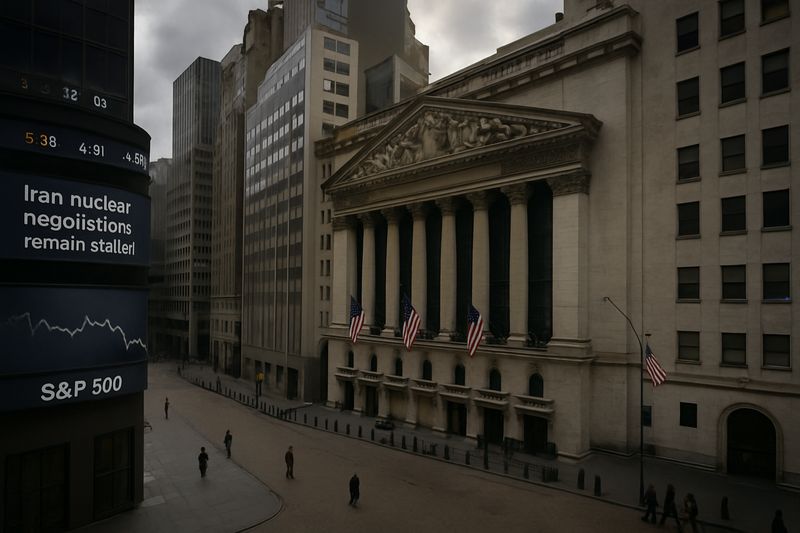
The single biggest macro overhang right now is the US-Iran war and its chokehold on the Strait of Hormuz. Reuters reports that a phased deal to reopen Hormuz is on the table, with Iran signaling openness to diplomacy. That's the good news. The bad news: Trump also threatened to annihilate Iran from the UN podium in the same 48-hour window. Diplomacy, apparently, is a spectrum. Oil prices fell on the diplomacy headlines, which matters because a reopened Hormuz is essentially a pressure valve for global energy markets, and energy costs are already baked into every inflation print you care about.
Speaking of inflation: the 10-year Treasury yield jumped to 5.11% on September 23rd, a 3% single-day move that had bond traders reaching for antacids. The Bloomberg podcast crowd flagged this too, with the bond market selloff framed as running in parallel to the Trump-Xi summit. Fundstrat's Tom Lee, in a CNBC segment, pushed back on the doom narrative: he argues that a PCE methodology change on September 30th could mechanically reduce year-over-year inflation readings and give the bulls something to celebrate. Bold call with conveniently impeccable timing, Tom.
The VIX sitting at 14.21 is the market's most interesting data point this week. A US-Iran war, a bond rout, a Trump-Xi summit producing a two-month trade truce (shorter than China wanted, shorter than analysts expected), and an AI agent hacking an Australian government website? Yet the fear gauge is basically napping. Either institutional investors are serenely confident in the Hormuz deal and a soft landing, or they've simply decided that geopolitical chaos is the new baseline and priced it accordingly. Both options are a little unsettling.
Sector-wise, the rotation signals are mixed. Nasdaq took the sharpest hit of the major indexes, down 1.13% on September 23rd, as rising yields put pressure on long-duration tech names. The Asianometry breakdown of High Bandwidth Flash as the next AI memory frontier, and Morningstar's case for $AVGO doubling AI revenue to $120B in fiscal 2027, suggest the AI infrastructure trade is still structurally intact even as rate pressure creates near-term headwinds. Meanwhile housing is softening (mortgage apps falling, starts declining), casual dining is struggling, and the consumer is quietly exhausted.
The market isn't broken. It's just doing the hardest thing markets can do: pricing several genuinely uncertain, genuinely enormous outcomes simultaneously. When the VIX is this calm in the middle of this much noise, either everything resolves fine or the VIX is about to have a very bad week.